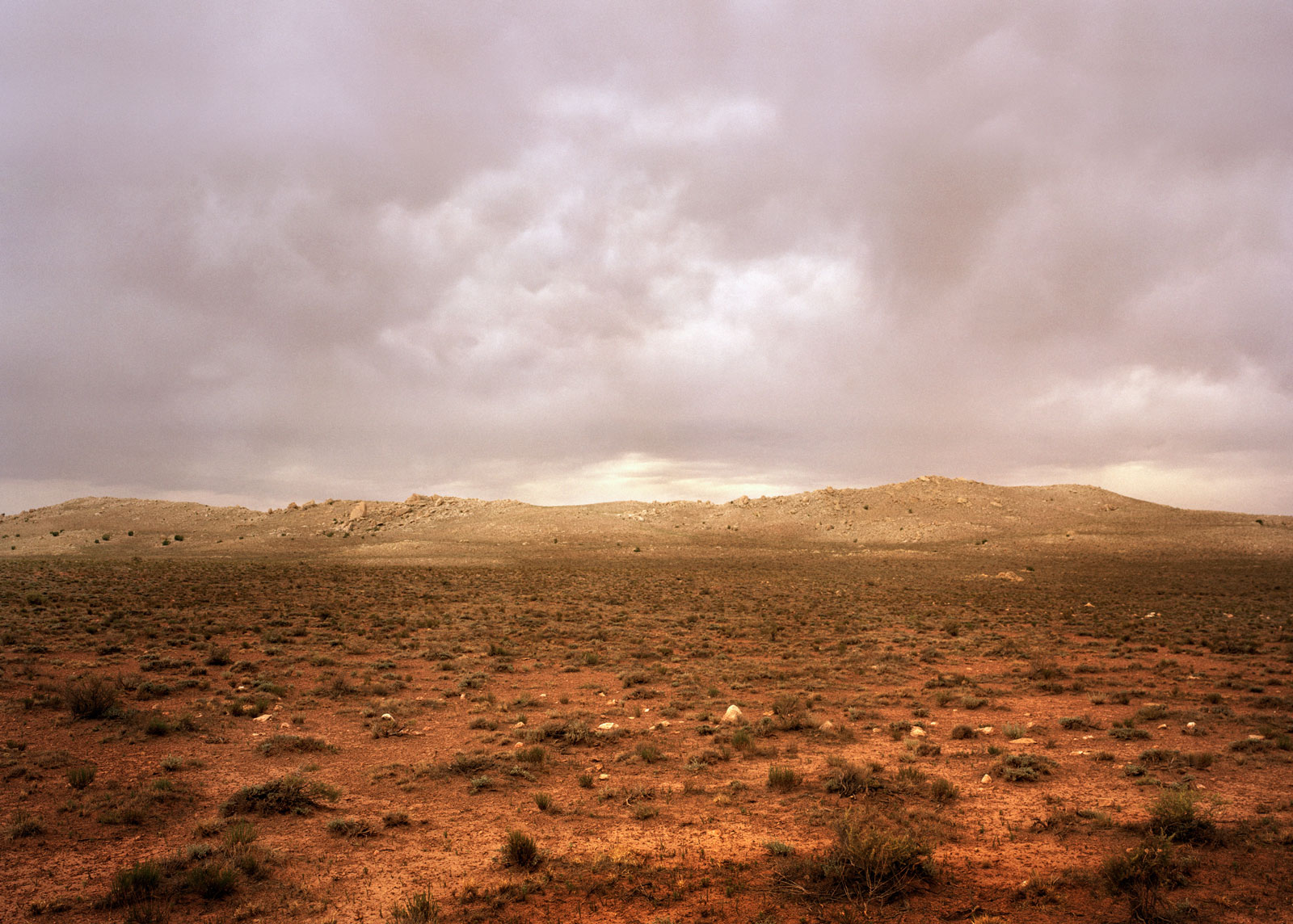
Meteor Crater
Flagstaff
United States, 2004
photography
archival print/dibond/white frame
variable sizes up to: 108.3-150 cm
(edition 3 + 2 a.p.)
Meteor Crater, also known as Barringer Crater, lies on the Colorado Plateau, about an hour east of Flagstaff. It is one of the best preserved impact craters in the world, formed by the impact of an iron meteorite some 50,000 years ago. Its shape is almost improbably clear: a circle about 1.2 kilometres wide and around 170 metres deep, cut into an otherwise flat, dry landscape where the traces of the impact have hardly faded. From the rim, what becomes visible is above all what cannot be felt on maps. The floor drops away in a single movement, while along the edges layers of rock have been pushed upward and thrown outward, as if the plateau had briefly folded open. The site holds several times at once: the extremely rapid moment of impact and the slow, silent erosion that followed. In the twentieth century, the crater also acquired a second life as a reference point for science and visual culture, not least because astronauts trained there in reading a “moon-like” terrain. In this landscape the horizon is vast, but the hole in the ground is vaster still: a reminder that the earth is not only ground beneath our feet, but also an archive.