Baia
Baia
Italy, 2026
photography
archival print/dibond/white frame
variable sizes up to: 120-150 cm
(edition 3 + 2 a.p.)
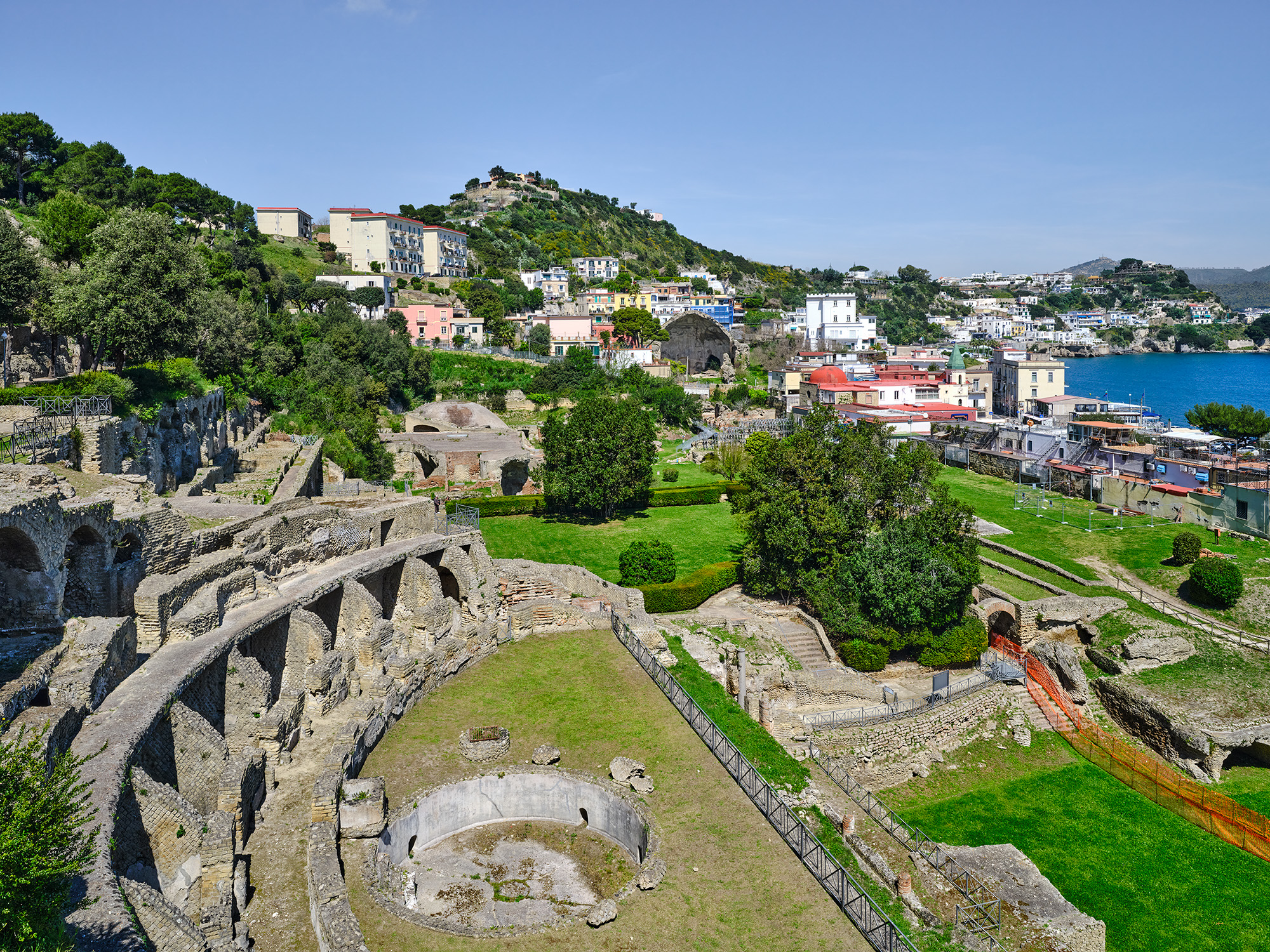
In this image, Hans Wilschut looks at Baia as a place where different times lie close together. In the foreground appear the remains of the Roman baths, once part of a luxurious coastal settlement where thermal springs, architecture and landscape were closely intertwined. Behind them lies the contemporary town, with its housing, infrastructure and everyday activity. The image does not present the ruin as an isolated classical fragment, but as part of a living and densely built urban environment.
It is precisely this proximity that makes Baia so distinctive. The archaeological remains do not seem to stand outside time, but are surrounded by the ordinary life of the present. Walls, domes and terraces carry the traces of Roman building culture, while behind them a contemporary urban reality unfolds, one that has entrusted itself to the same fragile ground. The past has not disappeared here, but has shifted, subsided, been exposed and absorbed again into the present.
Baia lies within the Campi Flegrei, a volcanic area where the ground is in constant motion. Bradyseism, the slow rising and sinking of the earth’s surface, has altered the coastline over the centuries and caused parts of the ancient city to disappear beneath the sea. This geological sensitivity adds another layer of tension to the image. What at first seems to be a meeting between ruin and town also becomes an image of instability, a landscape in which history, habitation and volcanic forces continue to intersect.
The work thus becomes a reflection on a place that never fully settles. Baia appears as a thin layer suspended between memory and use, between archaeology and contemporary urban life, between what has remained visible and what has slowly been displaced by the ground and the sea.