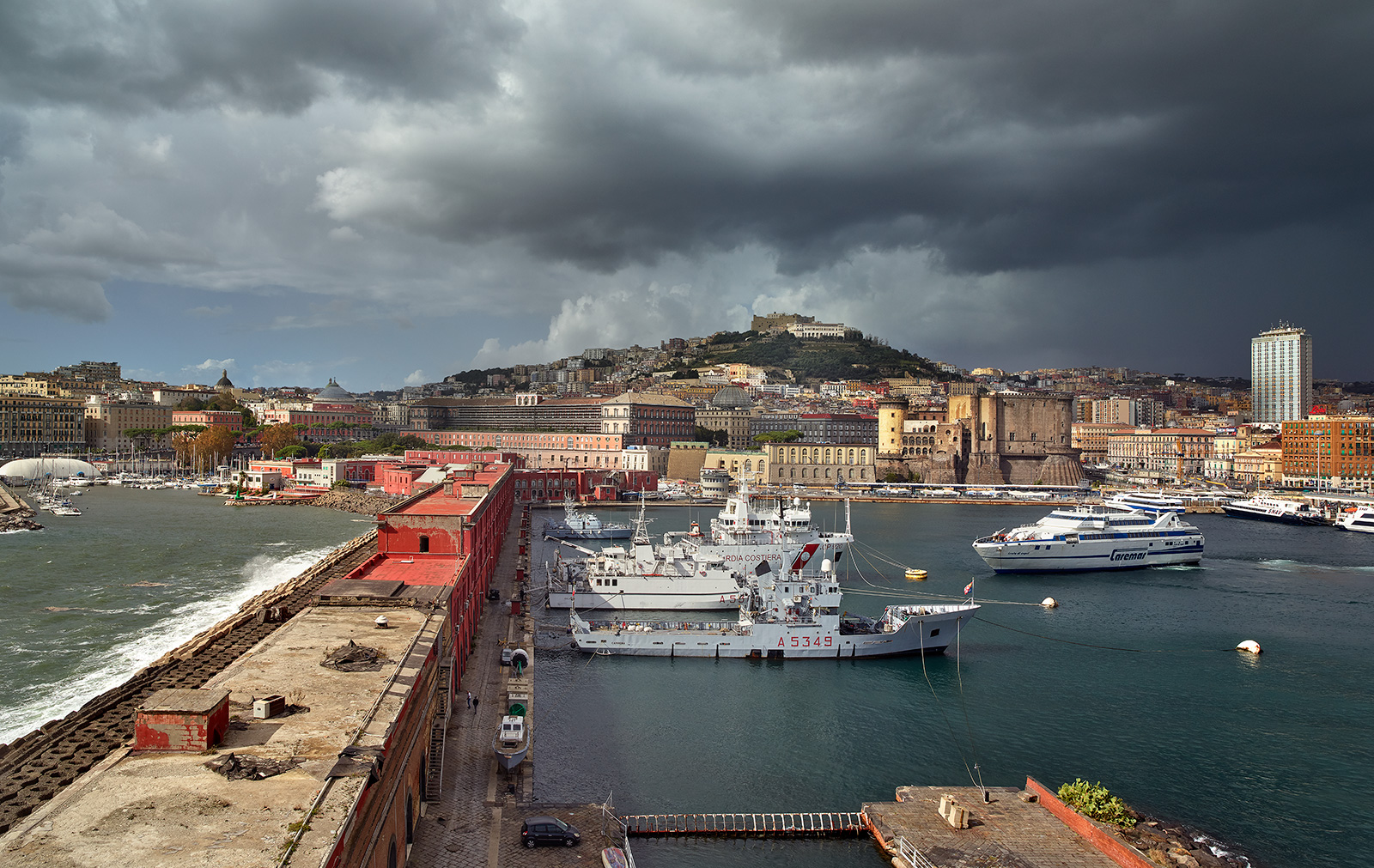
In 2019, photographer Hans Wilschut followed in the footsteps of Caspar van Wittel, the Dutch master who gained international renown between 1674 and 1736 for his Italian cityscapes. Commissioned by Kunsthal KAdE, Wilschut created new photographic vedute in Rome, Naples and Venice, cities that also play an important role in Van Wittel’s work.
The project was preceded by an intensive period of preparation. Consultations took place with the navy in Naples, security services in Rome and ACTV in Venice, the company that operates the city’s vaporetti. This practical groundwork was necessary in order to approach the cities from specific viewpoints. Wilschut explored how Van Wittel’s historical gaze could be translated into the present: not by literally reconstructing his work, but by looking at the city anew, with a comparable attention to perspective, architecture, urban dynamics and human use.According to Robbert Roos, director of Kunsthal KAdE, the choice of Wilschut was self-evident. In the years leading up to the commission, he had built up an extensive body of work consisting of photographic vedute, made in cities around the world. His work shows the city in a direct, sharp and often penetrating way. He frequently chooses an elevated viewpoint, a perspective that also characterises much of Caspar van Wittel’s work.Van Wittel was known for his precise rendering of architecture, his interest in the modern city of his time and his attention to the figures populating his street scenes. Related questions return in Wilschut’s work, but from a contemporary perspective. His photography focuses on the city as both an architectural and social space, and on the tension between the two. Themes such as globalisation, migration, urbanisation and the world economy play an important role in this. While Van Wittel captured the Italian city at a moment when it was becoming a beloved subject for collectors and travellers, Wilschut looks at the city as a complex and changing environment. His photographs do not so much show individual characters, but rather the structures in which urban life unfolds. As he puts it himself, he captures the fleeting nature of life not by photographing the actors in that great theatrical piece, but the stage set.