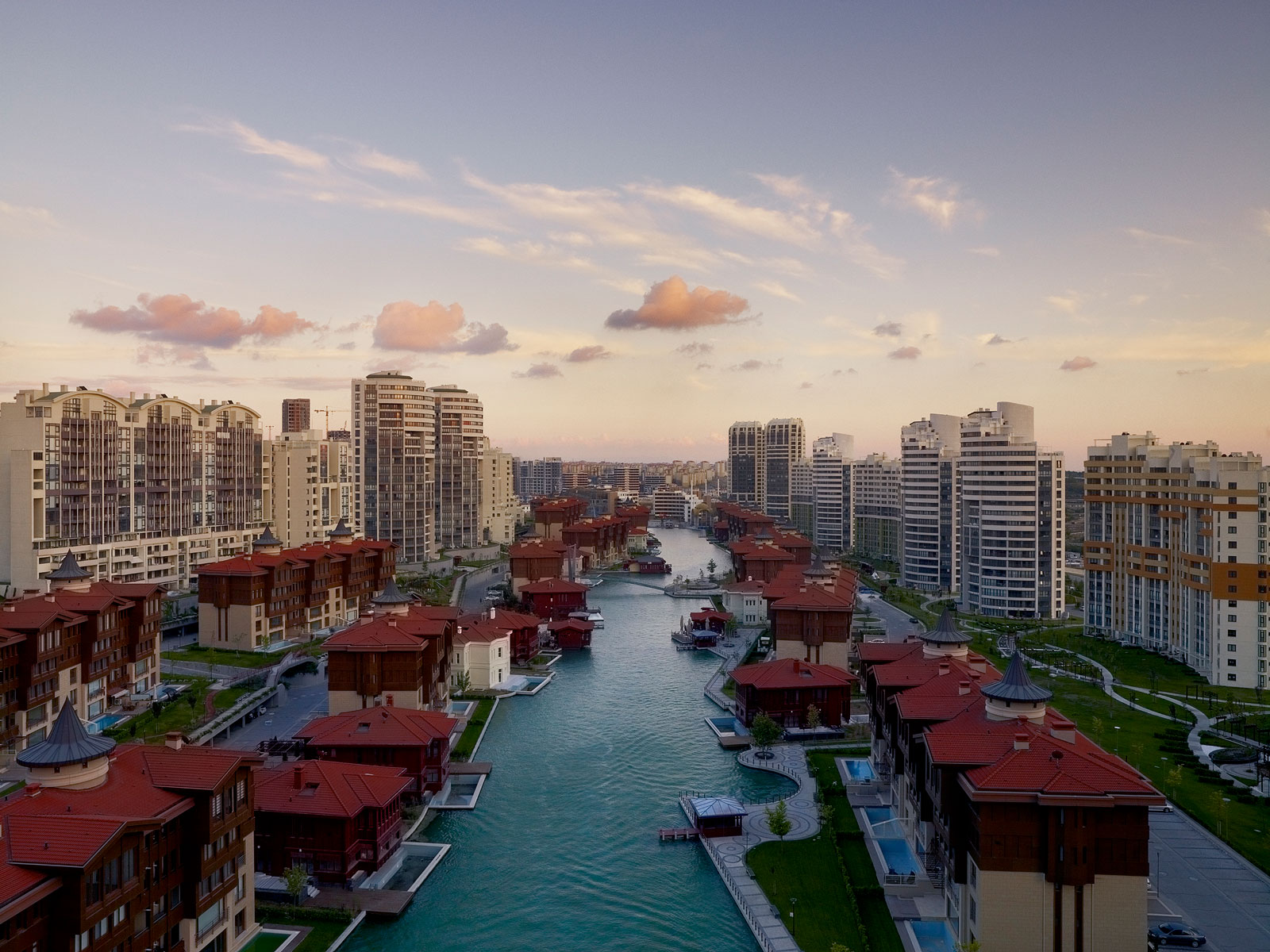
Ideals of Greatness was made in Istanbul at a moment when the city’s increasing scale had become ever more visible. Under Erdoğan, urban development shifted rapidly toward the outskirts, where housing compounds, infrastructure, and prestige projects were used to project a new image of progress. Within this expansion, the city no longer appears as a historically grown fabric, but as a sequence of large scale interventions in which land, the housing market, and political imagination converge.
Within that context, the work Bosphorus City occupies an almost surreal position. This large residential development in Halkalı presents itself as a miniaturised version of the Bosphorus, complete with artificial waterways, reconstructed quays, and references to well known neighbourhoods and yalıs along the strait. The Bosphorus, once a geographical and historical reality that gave the city its rhythm, is repeated here as a marketable backdrop on the periphery. What is offered as an exclusive lifestyle is at the same time a symptom of urban sprawl: the city expands by copying its own icons and staging them elsewhere. In Wilschut’s series, this logic becomes visible as a form of urban self imitation, in which grandeur no longer emerges from urban intensity, but from scale, repetition, and simulation.